No products in the cart.
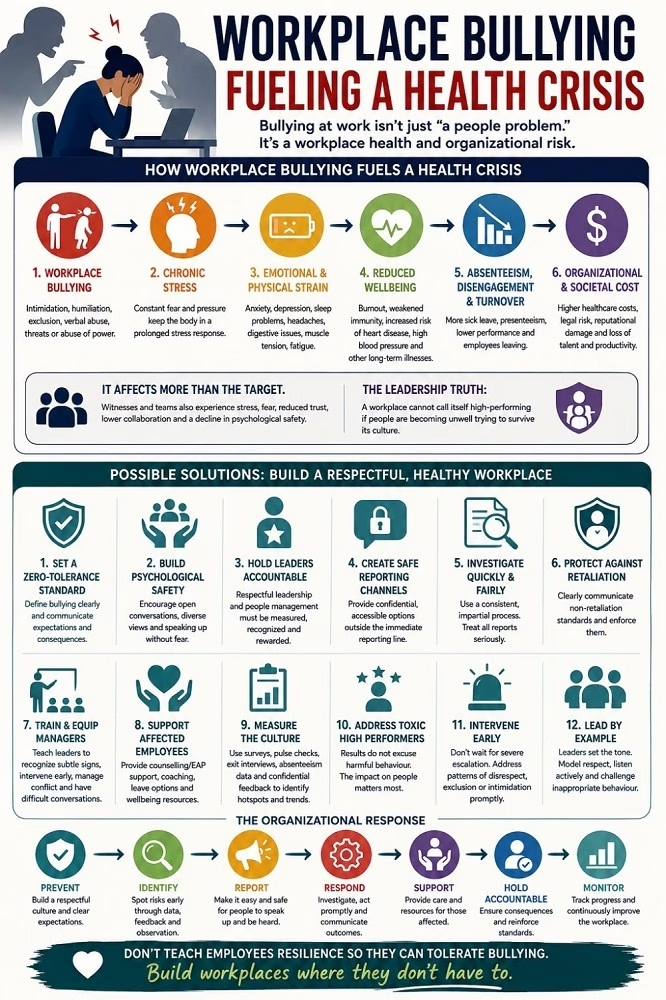
There is a health crisis unfolding in our workplaces that we do not talk about enough. Workplace bullying is turning out to be a major health crisis.
It does not always announce itself with a medical diagnosis. Sometimes, it looks like an employee who has stopped speaking in meetings. Someone who suddenly takes frequent sick days. A once-confident professional who now second-guesses every decision. Someone who sits in the parking lot for a few minutes before walking into the office, gathering the courage to face another day.
Sometimes, it looks like someone quietly saying:
“I am tired.”
And meaning much more than physical tiredness.
When work becomes a source of harm
Work should challenge us. It should stretch our abilities, develop our competence and sometimes take us outside our comfort zones.
But there is a profound difference between being challenged and being diminished.
Workplace bullying can take many forms—public humiliation, intimidation, persistent criticism, exclusion, belittling, threats, deliberate undermining, unreasonable demands or the misuse of authority.
What makes it particularly concerning is that it is often normalized.
We call it a tough management style.
We say, “That’s just how the boss is.”
We tell people, “Don’t take it personally.”
Or perhaps most damaging of all: “You need to be more resilient.”
But resilience should never become an excuse for tolerating harmful behaviour.
The person behind the employee
Every employee comes to work as a whole human being.
They have families, responsibilities, aspirations, fears and vulnerabilities that do not disappear when they badge into the office.
When someone is repeatedly exposed to hostility or humiliation, the impact does not necessarily end when they leave work.
They take it home.
It can affect their sleep, relationships, confidence, concentration and sense of self. The person who was once energetic begins to withdraw. The person who loved their work begins to dread Monday mornings.
And sometimes, nobody notices.
Or worse, everyone notices—but nobody wants to talk about it.
We need to stop confusing fear with performance
There is a troubling misconception in some workplaces that fear produces excellence.
It may produce compliance.
People may meet deadlines because they are afraid.
They may remain silent because speaking up feels dangerous.
They may work longer hours because they fear being labelled as uncommitted.
But fear is not engagement. Silence is not loyalty. And exhaustion is not productivity.
A workplace can achieve results while simultaneously damaging the people producing those results.
That is not sustainable success.
Leadership has a responsibility
This conversation is not about creating workplaces where people are never challenged.
It is about creating workplaces where people can be held accountable without being humiliated.
Good leaders can have difficult conversations.
They can address poor performance.
They can set high standards.
They can say no.
They can make unpopular decisions.
But they do these things while preserving the dignity of the person in front of them.
Leadership is not simply measured by what gets delivered.
It is also measured by what happens to people while it is being delivered.
Perhaps we are asking the wrong question
When an employee becomes disengaged, we often ask:
“Why has their performance changed?”
When someone resigns, we ask:
“Why couldn’t they cope?”
When absenteeism increases, we ask:
“Why are people becoming less committed?”
Perhaps we should sometimes ask:
“What are people experiencing at work?”
Because behind poor performance may be exhaustion.
Behind disengagement may be fear.
Behind a resignation may be years of feeling unheard.
And behind a seemingly ordinary Monday morning may be someone silently struggling to enter a workplace that has become emotionally unsafe.
This is bigger than HR
Workplace bullying cannot be left entirely to HR.
It is a leadership issue.
It is a culture issue.
It is a wellbeing issue.
And increasingly, it must be recognized as a health issue.
Policies matter. Reporting mechanisms matter. Employee Assistance Programmes (EAP) matter.
But culture is created in everyday interactions.
It is created in how managers speak to their teams.
How feedback is given.
How mistakes are handled.
How power is exercised.
How complaints are received.
And whether people feel safe enough to say, “This is not okay.”
We owe people better workplaces
People should not have to choose between their livelihood and their wellbeing.
They should not have to sacrifice their dignity to keep their jobs.
They should not have to become emotionally numb simply to survive their careers.
And organizations should not wait until someone breaks down, resigns or becomes seriously unwell before asking whether the environment itself contributed to the problem.
The workplace should be a place where people can perform without fear, grow without humiliation and succeed without losing themselves in the process.
We cannot keep talking about employee wellbeing while ignoring the behaviors’ that make wellbeing impossible.
Perhaps it is time to look beyond wellness programs and ask a harder, more uncomfortable question:
Are our workplaces making people well—or are some of them quietly making people sick?
Because behind every employee statistic is a human being.
And behind every human being is a life that matters.
We must do better.